Speculative Designs For Chinese 6th Gen Jets Take Flight
The aerospace world is abuzz, and for good reason. Whispers and intriguing imagery suggest that China's alleged sixth-generation fighter jet may have taken its maiden flight on December 26, emerging from the Chengdu Aircraft Industry Group's airfield, reportedly flanked by a J-20. This tantalizing development has ignited widespread speculation, offering a first glimpse into the future of Chinese air power and sparking intense interest in the Speculative Designs & Renders of Chinese 6th Gen Jets now making the rounds.
At a Glance: China's Next-Gen Air Ambitions
- First Flight Buzz: Social media suggests a prototype flew on December 26, escorted by a J-20, though details remain unconfirmed.
- Unique Design: Visuals indicate a tailless, highly swept-wing platform with cropped tips, a blended fuselage, and a W-like trailing edge, all optimized for stealth.
- Three Engines? Rumors point to a distinctive three-engine configuration – two underslung and one top-mounted.
- Dual Purpose Potential: Experts debate if it's a full 6th-gen fighter demonstrator or, more likely, an unmanned combat aircraft (UCAV) prototype for Manned-Unmanned Teaming (MUM-T).
- "White Emperor" Concept: AVIC's revealed "Baidi" concept at Zhuhai showcases a diamond-shaped, tailless design with advanced stealth and agility features.
- Strategic Shift: China's 6th-gen approach emphasizes networked kill-chains, AI-enabled teaming, and "loyal wingman" UCAVs, fundamentally altering air combat doctrine.
The Whispers Take Flight: Decoding Recent Sightings
Imagine the scene: a sleek, enigmatic aircraft, unlike anything seen before, emerging from a secure airfield. This is the scenario playing out across social media channels, hinting at what could be China's answer to the next generation of air superiority. The December 26 event, if confirmed, marks a pivotal moment, with the reported accompanying J-20 underscoring a lineage of advanced Chinese fighter development. The very act of a more established J-20's advanced capabilities escorting this new platform suggests either a coming-of-age for the newcomer or a planned integration into a combined operational concept.
Initial observations, though still firmly in the realm of speculation, have painted a fascinating picture. The most striking element is the rumored three-engine configuration – two engines nestled underneath the fuselage, with a third seemingly integrated on the top, featuring a distinct air intake. This alone sets it apart from conventional twin-engine fighter designs and immediately raises questions about thrust, stealth, and operational envelopes.
Design DNA: What the Visuals Tell Us About Stealth and Performance
When you look closely at the new imagery circulating, certain design characteristics jump out, all pointing towards an uncompromising focus on low observability. The aircraft appears unequivocally tailless, a hallmark of advanced stealth aircraft aiming to reduce radar cross-section. Instead of traditional empennage, we see a highly swept-wing design, meaning the wings angle sharply backward from the fuselage. This, combined with cropped wingtips, contributes significantly to radar stealth by minimizing reflective surfaces.
The fuselage itself looks broadly proportioned and blended seamlessly into the wing structure – a "blended wing body" concept that minimizes hard angles and edges where radar signals could scatter. A blended, pointed forward fuselage further enhances its stealth profile, allowing it to cut through the air with minimal resistance and radar detection. Completing this stealthy silhouette is a distinctive W-like trailing edge, another common feature in advanced low-observable designs that helps diffuse radar returns.
The robust nose gear and tricycle landing gear evident in the photos aren't just minor details. They strongly suggest a heavy, high-performance platform. This isn't a lightweight drone; it's designed to carry substantial internal fuel, advanced sensor suites, and potentially a significant weapons payload. The implications are clear: China is developing something substantial, capable of operating at the cutting edge of modern air warfare.
The 'Flying Wing' Paradox: Strengths, Limitations, and Strategic Choices
The overall silhouette strongly evokes a "flying wing" design philosophy. Think of the B-2 Spirit bomber – the entire aircraft contributes to lift, eliminating separate fuselage and tail structures. For an uncrewed platform, this design offers several compelling advantages. The primary benefit is a high payload-to-weight ratio; without the structural weight of a conventional fuselage and tail, more internal volume can be dedicated to fuel, sensors, or weaponry. This translates to extended range and endurance, critical for missions deep within contested airspace.
However, the "flying wing" isn't without its compromises. While excellent for stealth and endurance, it traditionally presents challenges in terms of maneuverability and stability. Without a tail, pitch and yaw control become more complex, relying heavily on complex flight control systems and differential thrust from engines. For a true fighter jet, high agility is paramount. This inherent trade-off in design is a key reason why experts are leaning towards the UCAV possibility rather than a manned fighter demonstrator. For missions focused on persistence, stealth, and carrying a heavy sensor or strike package, the benefits of a flying wing often outweigh the maneuverability drawbacks. Understanding principles of stealth aircraft design highlights how these choices are meticulously calculated.
Engines and Egress: Peering into Propulsion and Weaponry
Let's delve deeper into the intriguing propulsion system. The rumored three-engine configuration is a significant departure. While two engines are reported underneath the wing/nose area, typical for many stealth designs to shield hot exhaust plumes, the supposed top-mounted air intake and engine nozzle are particularly noteworthy. Placing engine nozzles above the fuselage, rather than below or behind, offers yet another layer of radar stealth and helps to obscure the infrared signature from ground-based sensors. This design choice implies a highly sophisticated approach to reducing detectability across multiple spectrums.
Similarly, the photos suggest possible missile or bomb loading hatches located underneath the fuselage. Internal weapons bays are a non-negotiable feature for any true 6th-generation platform, as externally carried ordnance would severely compromise a jet's radar cross-section. These internal bays, combined with sophisticated loading mechanisms, ensure that the aircraft maintains its stealth profile even when fully armed. This focus on internal carriage and exhaust shielding points to an aircraft designed to operate in highly contested environments, where detection means destruction.
Unmanned or Manned? Pinpointing the Purpose of China's Next-Gen Platform
The million-dollar question: Is this a prototype for an unmanned combat aircraft (UCAV) or a demonstrator for a 6th-generation manned fighter? While the dream of a fully crewed 6th-gen fighter is enticing, expert sources overwhelmingly lean towards the UCAV possibility.
The design characteristics – particularly the flying wing shape and its inherent trade-offs in maneuverability – align more closely with what we'd expect from a sophisticated UCAV. Such an aircraft would prioritize long endurance, deep penetration capabilities, and the ability to carry a diverse payload (whether advanced sensors, electronic warfare systems, or precision-guided munitions) over extreme dogfighting agility.
This focus strongly suggests Manned-Unmanned Teaming (MUM-T). In this paradigm, a crewed fighter (like the J-20) acts as a command node, directing multiple autonomous UCAVs – often referred to as "loyal wingmen" – into dangerous or contested airspace. The UCAVs would perform tasks too risky for human pilots, extending the reach, sensor coverage, and strike capability of the manned platform. This concept mirrors developments seen elsewhere, such as Russia's S-70 "Hunter" UCAV, which shares a similar tailless, flying-wing aesthetic. The global trend towards the future of UCAVs makes this a highly probable direction for China. If you're looking to understand the core strategic advantage, you need to grasp MUM-T strategies.
The Official Line: China's Roadmap to Air Dominance
While the recent sightings are generating buzz, China's 6th-generation aircraft development isn't entirely a clandestine affair. Official statements confirm a clear strategic intent. Dr. Wang Haifeng, the chief designer at Chengdu Aerospace Corporation (CAC), confirmed in 2019 that pre-research for a 6th-generation platform was formally underway. This isn't just theoretical; by 2018, Chengdu Aerospace Corp had already put eight different designs on the drawing board, with four proceeding to wind tunnel testing – a crucial step in validating aerodynamic concepts.
The timeline suggests a comprehensive, long-term vision. A full program rollout, encompassing production and deployment, is predicted by 2035. This indicates that China is not rushing a single design but systematically exploring various concepts, validating technologies, and building a foundation for future air superiority. This methodical approach underscores the seriousness of their commitment to next-generation air power.
AVIC's "White Emperor": A Vision of Future Air Power
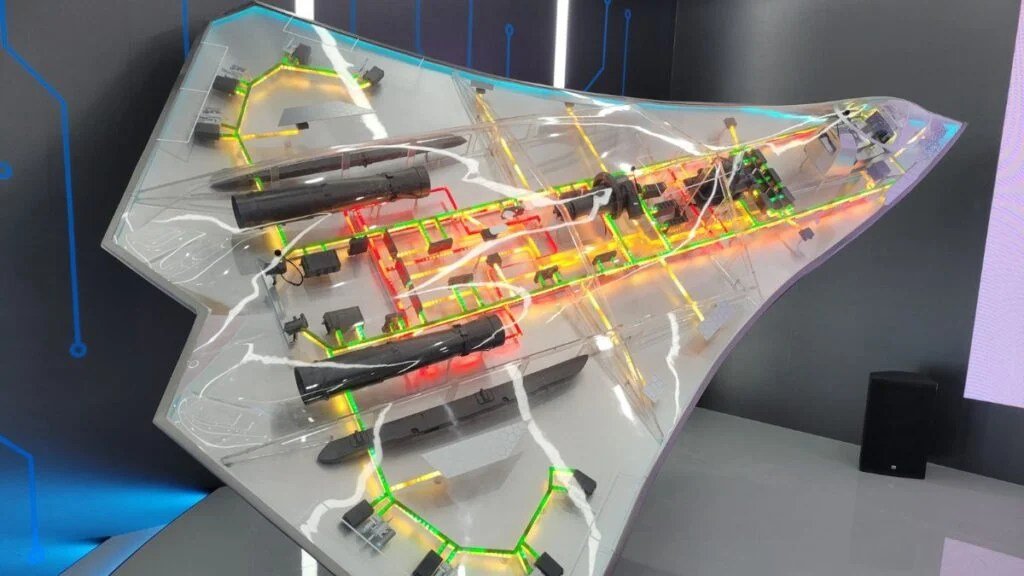
Beyond the recent alleged sighting, we have a more "official" glimpse into China's 6th-generation aspirations: the Aviation Industry Corporation of China (AVIC) unveiled its "White Emperor" (Baidi) concept. This wasn't a flying prototype but a detailed mock-up showcased at the 2024 Zhuhai Airshow – China's premier aviation exhibition.
The "White Emperor" presents a striking, futuristic vision. It features a diamond-shaped, tailless design, again emphasizing stealth. AVIC describes it as an "integrated space-air fighter," a bold claim suggesting capabilities far beyond current atmospheric flight. Its design boasts stealth, agility, and supersonic speeds, key performance parameters for a next-generation fighter. Like the alleged prototype, it features internal weapons bays, essential for maintaining low observability.
One particularly intriguing detail is the dark, multi-faceted cockpit canopy, designed to reduce radar reflectivity – a strong hint that even if the primary role of future platforms shifts towards UCAVs, manned versions are still very much part of the strategic consideration. While claims of "space operation capability" remain unconfirmed and sound highly ambitious, they signal China's intention for these platforms to push the boundaries of current aerospace technology, aiming to compete directly with the U.S. F-22 Raptor and F-35 Joint Strike Fighter, and potentially even surpass them in specific mission sets.
Beyond the Jet: China's Holistic 6th-Gen Strategy (MUM-T & Networked Warfare)
Here's where China's 6th-generation strategy truly differentiates itself: it's not just about building a single, better fighter jet. Instead, Beijing plans to integrate these advanced platforms, whether manned or unmanned, as critical nodes within a distributed, networked kill-chain throughout the People's Liberation Army (PLA). This is a fundamental shift from one-for-one replacements of current fighters.
The new doctrine and procurement will prioritize:
- Sensor Fusion: Seamlessly combining data from diverse sensors across multiple platforms – air, space, ground, and sea.
- Secure Datalinks: Robust, encrypted communication channels ensuring real-time information flow and resilience against electronic warfare.
- AI-Enabled Teaming: Artificial intelligence orchestrating the complex interactions between manned and unmanned assets, making real-time decisions and adapting to dynamic battlefield conditions.
Crucially, crewed jets like the J-20 (and potentially future 6th-gen manned fighters) are envisioned as command nodes, orchestrating formations of autonomous "loyal wingman" UCAVs. These UCAVs would extend the manned platform's sensor reach, carry additional weapons, conduct electronic warfare, or even act as decoys, dramatically multiplying the combat power and survivability of the entire formation.
This approach requires significant technological investment. Chinese engineers are prioritizing: - High Electrical-Power Generation: To power advanced sensors, electronic warfare systems, and directed energy weapons.
- Open-Architecture Sensor Fusion: Allowing for rapid upgrades and integration of new technologies.
- Hardened, Low-Latency Datalinks: Ensuring secure and swift communication in contested environments.
Such a comprehensive strategy drives profound shifts across the entire PLA and PLAAF: - Force Structure: Moving towards MUM-T squadrons, where manned and unmanned assets operate as a cohesive unit.
- Basing: Transitioning to distributed basing to reduce vulnerability to concentrated attacks.
- Logistics: Developing hardened support infrastructure and resilient sustainment chains for complex systems.
- Training: Overhauling pilot and operator training to master complex systems integration, AI interaction, and command of autonomous assets.
Tactical Implications: Reshaping Regional Air Combat
The deployment of such integrated 6th-generation platforms would have significant tactical and strategic implications, especially within the First Island Chain and for potential contingencies in the Indo-Pacific.
- Extended Reach & Survivability: This integrated approach would dramatically extend the PLA/PLAAF's reach and ability to operate inside heavily defended airspace, improving survivability against layered air defenses by saturating and confusing adversary systems.
- Complicating Allied Operations: For adversaries, this networked kill-chain complicates targeting and intelligence, surveillance, and reconnaissance (ISR) collection. It becomes much harder to identify high-value targets when combat power is distributed across numerous, stealthy, and interconnected platforms.
- Raising the Intervention Threshold: The enhanced capabilities and complexity of China's future air forces would inevitably raise the threshold for allied intervention in regional contingencies, making any potential conflict significantly riskier and more challenging.
- Countering the Threat: Adversaries, including the U.S. and its allies, would be compelled to prioritize counter-network operations, electronic warfare capabilities, and resilience measures to degrade China's distributed air power. This is already driving programs like the Next Generation Air Dominance (NGAD) program in the U.S., which pursues a similar integrated approach of 6th-gen fighters and advanced drones.
What's Next on the Horizon for 6th-Gen Developments
The alleged first flight of a new Chinese prototype, coupled with the "White Emperor" concept, underscores a pivotal moment in global military aviation. While many details remain shrouded in secrecy and are subject to confirmation, the direction is clear: China is investing heavily in a future where air combat is defined by stealth, networked intelligence, artificial intelligence, and sophisticated Manned-Unmanned Teaming.
For observers, the coming years will be crucial. We'll be looking for more definitive imagery, official confirmations, and further details on the specific capabilities and roles of these emerging platforms. The race for 6th-generation air dominance is officially underway, and China has just shown its hand, signaling a future where the skies will be even more contested and technologically advanced. You can always View 6th gen fighter photos as new information emerges.